
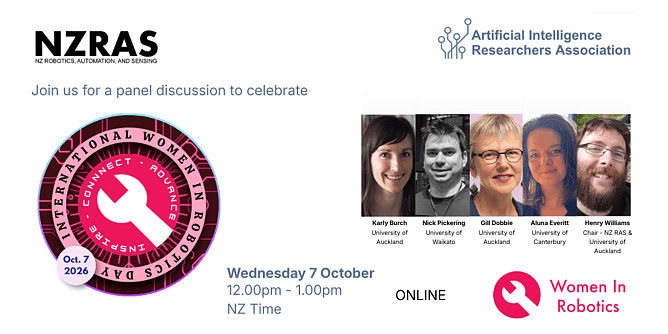
Robotics is changing rapidly, but its future will depend on more than advances in technology. It will also depend on who is involved in developing it, whose perspectives are considered, and which problems we choose to solve.
This was a central theme of a special International Women in Robotics Day webinar, held on 7 October 2026, bringing together researchers from across Aotearoa New Zealand to explore the future of robotics and AI, the importance of diversity, and how to encourage more women and underrepresented groups into the field.
Hosted collaboratively by the Artificial Intelligence Researchers Association and New Zealand Robotics, Automation and Sensing (NZRAS), the discussion was moderated by NZRAS Chair Henry Williams, with panellists Professor Gill Dobbie (University of Auckland), Dr Karly Burch (University of Auckland), Dr Aluna Everitt (University of Canterbury) and Nick Pickering (University of Waikato).
Different pathways, shared opportunities
One of the strongest messages was that robotics is inherently interdisciplinary. The panellists shared diverse pathways into the field, spanning engineering, artificial intelligence, sociology, human-computer interaction and systems design.
Karly Burch described her involvement in collaborative robotics research from a social science perspective, while Aluna Everitt discussed her work in soft robotics, wearable technologies and accessible design. Gill Dobbie reflected on the rapid evolution of AI and its potential to transform robotics, particularly through systems tailored to New Zealand's unique needs. Nick Pickering highlighted how increasingly accessible technologies are enabling innovative applications, from environmental monitoring to assistive devices.
Together, their experiences demonstrated that robotics is not just for engineers and computer scientists. It offers opportunities for people with a wide range of skills, interests and backgrounds.
Why diversity matters in robotics
The conversation explored how diversity directly influences the technologies we create.
Karly emphasised that bringing different disciplines, cultures and lived experiences into research and development helps identify potential risks and opportunities that might otherwise be overlooked.
Aluna reinforced the importance of responsible innovation, encouraging researchers to consider not only the immediate users of technology but also the wider communities who may be affected.
Gill highlighted how diverse teams can challenge assumptions, reduce bias and expand the range of problems robotics can address.
Practical examples, including co-designed orchard automation, demonstrated how involving end users early can produce technologies that are safer, more accessible and better suited to real-world needs.
Encouraging more women into robotics
Increasing women's participation requires more than encouraging girls to study engineering.
The panellists discussed the importance of early exposure to STEM, visible role models, inclusive learning environments and alternative pathways into technology careers.
Initiatives such as the University of Waikato's She Eng programme were highlighted as practical ways to introduce young people to engineering.
Gill also emphasised the need to celebrate the achievements of women already working in robotics and ensure they have opportunities to lead research and technology development.
There was broad agreement that schools, universities, industry and professional associations all have a role in building more coordinated and accessible pathways.
Opportunities for Aotearoa New Zealand
Looking ahead, the panel identified significant opportunities for robotics and AI across agriculture, aquaculture, environmental monitoring, healthcare and aged care.
The discussion also highlighted the importance of developing technologies that reflect Aotearoa New Zealand's values and communities, including responsible innovation, collaborative design and Māori data sovereignty.
A recurring theme was that technology should support people rather than simply replace them — helping make dangerous or physically demanding work safer while allowing people to focus on activities requiring human judgement, care and connection.
Be stubborn about your interests
The webinar concluded with a question about what advice panellists would give someone interested in robotics or AI who did not see themselves as an engineer or computer scientist.
Aluna Everitt's response captured the spirit of the discussion:
"Be stubborn about your interests. Persevere."
Others encouraged people to explore different pathways, connect with researchers and innovators, and not let traditional expectations limit their ambitions.
Ultimately, the discussion reinforced that the future of robotics will be shaped not only by technological advances, but by the diversity of people contributing to them.
Creating opportunities for more people to participate, collaborate and lead will be essential to building a robotics and AI ecosystem that benefits all of Aotearoa New Zealand.
The AI Researchers Association thanks New Zealand Robotics Automation and Sensing, moderator Henry Williams and all our panellists for contributing to this important conversation.